DLCO
What is DLCO?
DLCO testing provides insight into the pulmonary system’s function of transferring gases in the alveoli across the alveolar/capillary (A/C) membrane into the capillary blood and into the red blood cells (RBC). DLCO is also referred to as the transfer factor for carbon monoxide or TLCO.4
The DLCO test uses a mixture of gases containing air, carbon monoxide, and a tracer gas (ie, helium) to determine the transfer of gas from alveoli to RBC. Carbon monoxide (CO) behaves much like oxygen and is quickly picked up in the RBC by hemoglobin. The tracer gas is used in the DLCO test to measure alveolar volume.
What is diffusion?
When you breathe air in, the oxygen travels through your airways into small air sacs (alveoli). From there, your blood picks up the oxygen as it travels through nearby blood vessels (capillaries). Your blood delivers the oxygen to your tissues to use for energy. A number of factors determine how well oxygen transfers from your lungs to your blood (diffusion), including:
- The amount of surface area in your alveoli.
- The amount of blood in your capillaries.
- The concentration of hemoglobin (a protein that carries oxygen) in your blood.
- The thickness of the membrane between your alveoli and capillaries.
- Excess fluid in your alveoli.
What is lung diffusion testing (DLCO) used for?
Lung diffusion testing can be used to:
Understand what’s causing certain symptoms such as shortness of breath, coughing or wheezing.
Assess lung damage.
Screen for certain lung diseases.
Evaluate how well your lungs are working before surgery or beginning a strenuous exercise program.
Understand how an underlying disease is affecting your lung function.
Get information on how well a treatment is working.
Help track whether an existing condition is getting better or worse.
How does a DLCO test work?
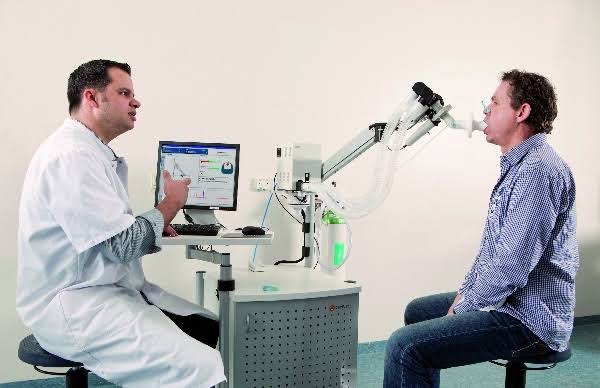
A DLCO test uses a special mixture of gas to measure how well oxygen and carbon dioxide are moving between your lungs and your blood. During the test, you breathe in a gas that’s a mixture of nitrogen and oxygen (which naturally make up most of the air you breathe), plus:
- A small amount of carbon monoxide (not enough to hurt you), which should move easily from your lungs to your blood.
- A small amount of a tracer gas, like methane. A tracer gas isn’t absorbed into your blood and helps measure the amount of carbon monoxide absorbed.
When you breathe in, your blood absorbs some or all of the carbon monoxide from the gas in your lungs. When you breathe out into the machine, it measures how much carbon monoxide your blood absorbed based on how much is left in the gas you breathed out. This measurement can give your provider clues as to how well your lungs are working.
What causes low DLCO?
Many things can cause a low DLCO. Some specific causes include:
- Smoking.
- Cystic fibrosis.
- COPD (chronic obstructive pulmonary disease).
- Emphysema.
- Sarcoidosis and other interstitial lung diseases.
- Heart and blood conditions, like pulmonary embolism (PE), pulmonary arterial hypertension, congestive heart failure and anemia.
- Autoimmune disorders like mixed connective tissue disease, scleroderma and lupus (SLE).
What causes high DLCO?
Some conditions cause you to have a higher DLCO than expected. These include:
- Obesity.
- Asthma.
- Exercising before the test.
- High altitude.
- Bleeding in your lungs.
- Cardiac shunt.
- Heart failure.
- Polycythemia vera.